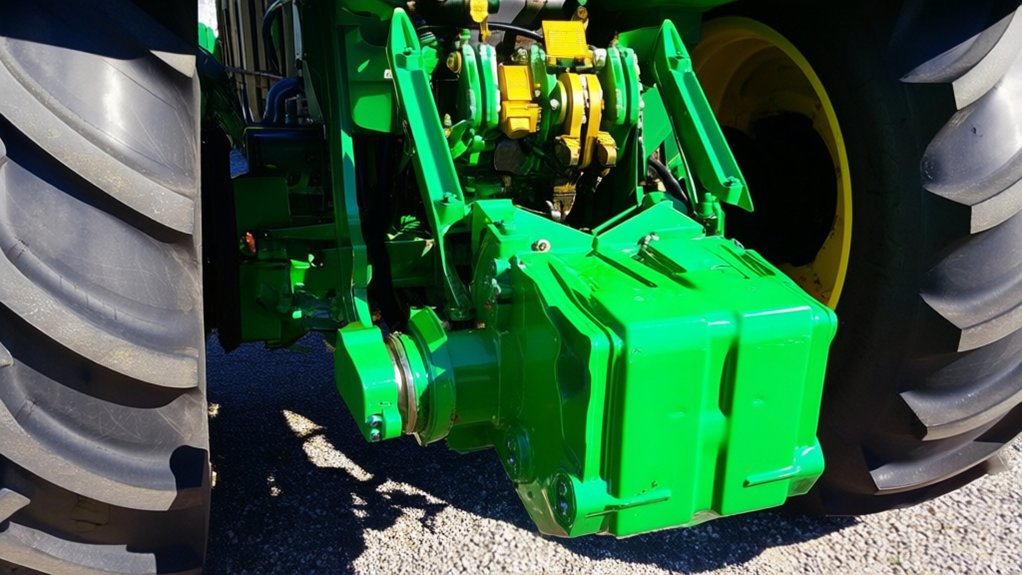
What Does MFWD Mean on Tractors?
MFWD on tractors means Mechanical Front-Wheel Drive, which powers both front and rear wheels to improve traction and control. You’ll benefit from better grip on slippery or uneven ground and enhanced maneuverability around tight spaces. This system engages automatically or manually to reduce wheel slip and boost overall handling. If you want to understand how MFWD works, which tractors commonly use it, and when it’s the best choice, keep exploring for more insights.
Key Takeaways
- MFWD stands for Mechanical Front-Wheel Drive, delivering power to both front and rear tractor wheels for improved traction.
- It uses a transfer case and center differential to distribute engine power between front and rear axles efficiently.
- MFWD engages automatically when wheel slip is detected or manually via a lever, switch, or button near the operator.
- This system enhances tractor stability, steering responsiveness, and reduces wheel slip on slippery or uneven terrain.
- MFWD is common on utility, row-crop, and orchard tractors, making them versatile and more capable for various farm tasks.
What Does MFWD Mean on Tractors?
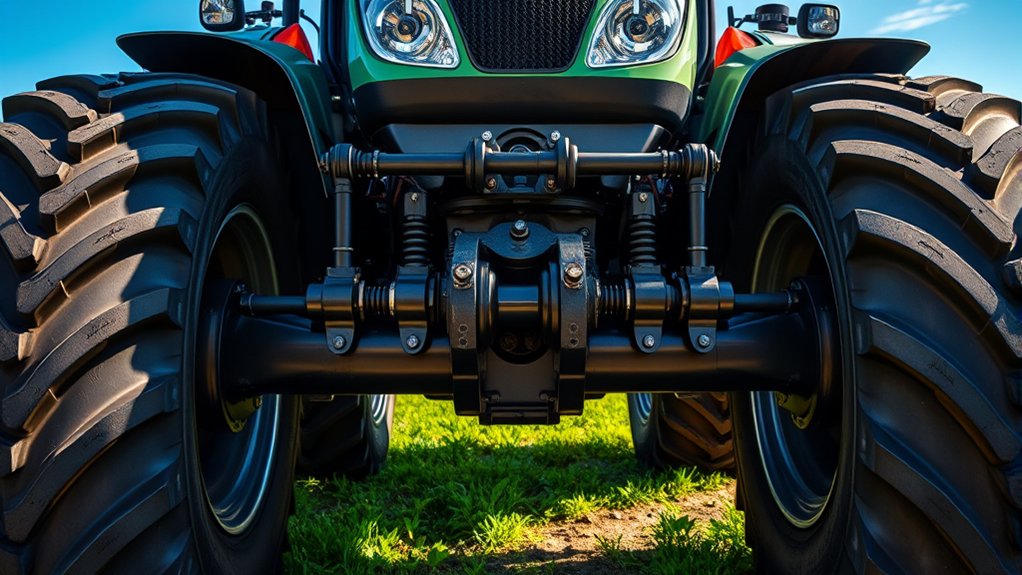
What exactly does MFWD mean on tractors? MFWD stands for Mechanical Front-Wheel Drive. When you see this term, it indicates that the tractor has a system delivering power to both the rear and front wheels. This setup improves traction and stability, especially on uneven or slippery terrain. You’ll find MFWD tractors helpful when working in fields, as they provide better control and reduce wheel slip. Unlike standard two-wheel drive tractors, MFWD models can handle tougher conditions without losing grip. This feature makes your tractor more versatile and capable. Understanding MFWD lets you choose the right tractor for your needs, ensuring efficient performance whether you’re plowing, hauling, or performing other demanding tasks on your farm.
How Does MFWD Work?
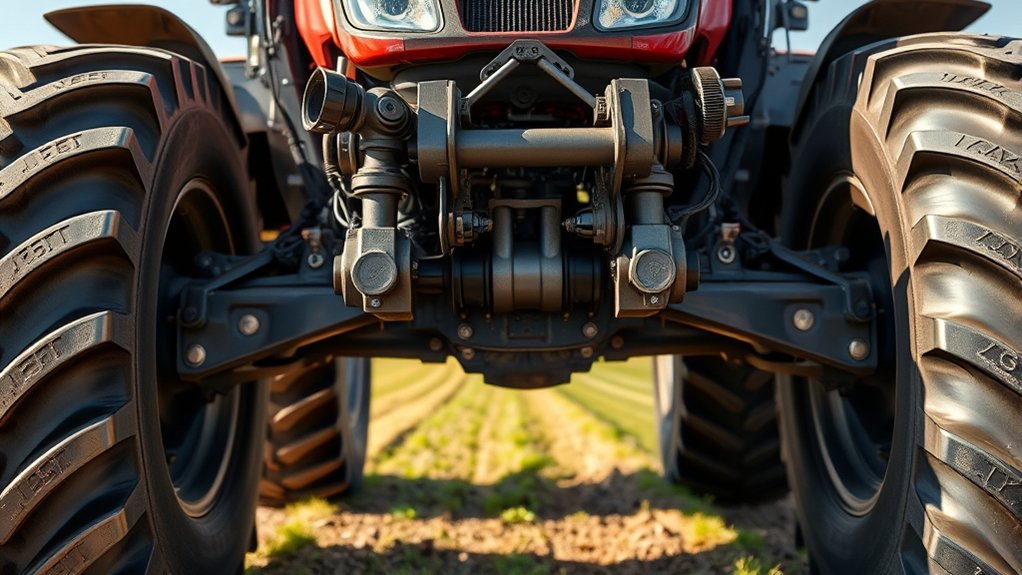
You’ll find that MFWD works by distributing power between the front and rear wheels to improve traction. The system uses engagement and control components to manage when and how the front wheels receive power.
Understanding these mechanisms will help you see why MFWD enhances your tractor’s performance.
Power Distribution Mechanism
Although tractors come with various drivetrain options, the power distribution mechanism in MFWD systems plays an essential role in enhancing traction and control.
In MFWD tractors, power from the engine first travels through the transmission to the main driveshaft. Then, a transfer case splits that power between the front and rear axles. This balanced distribution ensures both axles receive torque simultaneously.
Additionally, a center differential or a similar device manages the difference in rotation speed between front and rear wheels, preventing drivetrain binding. This system allows you to maintain grip on uneven or slippery terrain by delivering power where it’s needed most.
Engagement and Control Systems
Since MFWD systems rely on precise engagement and control, understanding how they activate is key to maximizing your tractor’s performance.
Typically, MFWD engages automatically when the tractor senses wheel slip, using sensors to detect loss of traction. You can also manually control engagement through a lever or switch in the cab, depending on your tractor model.
Once activated, a clutch or hydraulic system transfers power to the front wheels, improving grip and stability. This engagement happens smoothly to avoid drivetrain shock, ensuring consistent power delivery.
You’ll find some tractors offer adjustable settings for how aggressively MFWD engages, letting you tailor performance to your field conditions.
Common Tractor Types That Use MFWD
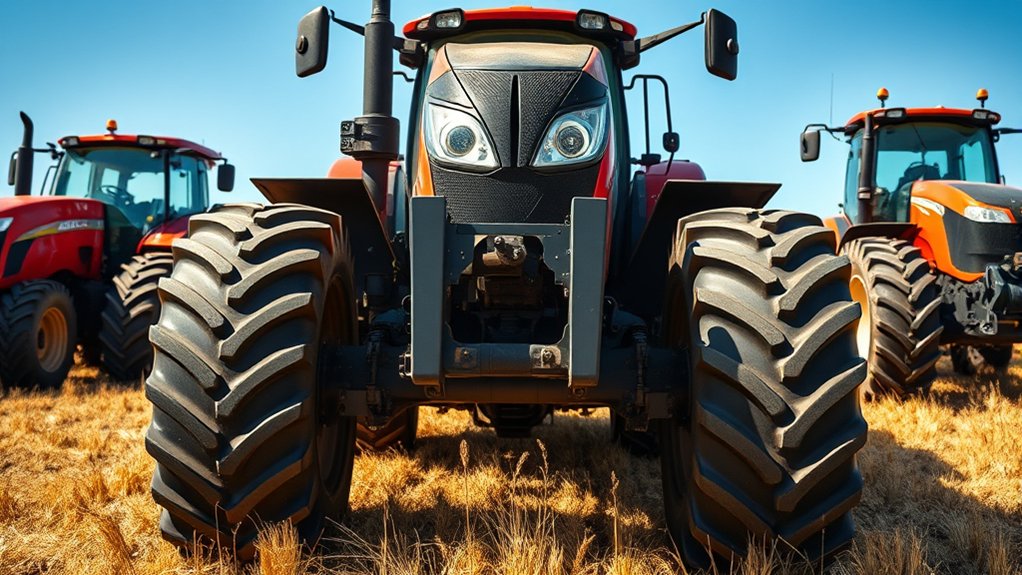
When you choose a tractor equipped with MFWD (Mechanical Front-Wheel Drive), you’re often looking for enhanced traction and maneuverability. You’ll find MFWD commonly on utility tractors, row-crop tractors, and orchard tractors.
Utility tractors benefit from MFWD because it helps you handle diverse tasks like landscaping and light tillage with better grip.
Row-crop tractors often use MFWD to maintain control and stability in muddy or uneven fields, especially during planting and harvesting.
Orchard tractors, designed for narrow rows, rely on MFWD to improve steering precision without sacrificing traction.
In all these types, MFWD enhances your tractor’s overall performance on varied terrain, making it a versatile choice whether you’re managing crops, hauling, or performing general farm work.
Why MFWD Helps on the Farm
Why does MFWD make such a difference on the farm? It improves your tractor’s traction by powering the front wheels along with the rear ones, helping you maintain control in slippery or uneven conditions.
When you’re hauling heavy loads or working on soft ground, MFWD prevents wheel slip and reduces soil compaction, protecting your fields.
It also enhances steering responsiveness, making it easier to maneuver around tight spots and obstacles.
You’ll find that MFWD boosts your efficiency, letting you work faster without sacrificing stability.
Plus, it reduces wear on tires and drivetrain components by distributing power more evenly.
Key Differences Between MFWD and 4WD Tractors
Although both MFWD and 4WD tractors provide power to all wheels, they differ considerably in design and performance.
MFWD, or Mechanical Front-Wheel Drive, mainly powers the front wheels through a mechanical linkage, enhancing traction and steering without powering the front axle independently.
MFWD boosts traction and steering by powering the front wheels via mechanical linkage, not independently powering the front axle.
In contrast, 4WD tractors deliver power to both front and rear axles, offering full four-wheel drive capability. This means 4WD tractors generally provide better traction in tough conditions but can be heavier and more complex.
You’ll notice MFWD tractors are lighter, more maneuverable, and usually less expensive, making them ideal for lighter fieldwork and transport.
Meanwhile, 4WD tractors excel in heavy-duty tasks and rough terrain.
Understanding these differences helps you pick the right tractor for your specific farming needs.
Choosing MFWD vs. Other Tractor Drive Options
Since selecting the right tractor drive affects your efficiency and costs, you need to weigh the benefits of MFWD against other options like 2WD and full 4WD.
MFWD offers improved traction and steering control compared to 2WD, making it ideal if you work on varied terrain but don’t require the full power of 4WD. It’s often more fuel-efficient and less expensive to maintain than full 4WD, which can save you money in the long run.
However, if you need maximum traction for heavy-duty tasks or extremely rough conditions, 4WD might be better.
On the other hand, 2WD tractors usually cost less upfront and suit lighter, flat-field work.
Ultimately, your choice should match your workload, terrain, and budget to get the best balance of performance and value.
When Does MFWD Improve Tractor Traction Most?
When you tackle uneven or slippery ground, MFWD considerably boosts your tractor’s traction by engaging all four wheels for better grip. This system shines in conditions where rear-wheel drive alone can’t maintain steady contact or power transfer.
MFWD enhances tractor traction by engaging all four wheels, ensuring better grip on challenging terrain.
You’ll notice the most traction improvement when:
- Steering through muddy or wet fields where tires can easily slip
- Climbing steep inclines that require extra wheel grip to prevent sliding
- Pulling heavy implements that demand consistent power distribution to avoid wheel spin
How MFWD Affects Tractor Maneuverability
You’ll notice MFWD gives you enhanced traction control, which makes steering more precise in tricky conditions. It helps reduce wheel slip, so you maintain better grip on uneven terrain.
Let’s explore how these benefits improve your tractor’s maneuverability.
Enhanced Traction Control
Although tractor maneuverability depends on several factors, MFWD substantially enhances your control by providing improved traction on uneven or slippery terrain. This system engages all four wheels, giving you a stronger grip and reducing slippage when conditions get tough.
With MFWD, you can confidently tackle muddy fields, steep slopes, or loose soil without losing momentum.
Here’s how MFWD boosts your tractor’s traction control:
- Distributes power evenly to front and rear wheels for balanced grip
- Minimizes wheel spin, increasing efficiency and reducing soil compaction
- Adapts to changing terrain, maintaining steady forward motion
Improved Steering Precision
By engaging all four wheels, MFWD not only boosts traction but also sharpens your tractor’s steering precision. This means you get smoother, more responsive handling, especially in tight turns or uneven terrain. You’ll notice less effort is needed at the wheel, making long hours in the field less tiring. MFWD distributes power to the front wheels, improving front-end grip and reducing understeer. This allows you to maneuver confidently in confined spaces and around obstacles.
| Aspect | Benefit |
|---|---|
| Four-Wheel Engagement | Better front wheel control |
| Steering Response | Faster, more precise turns |
| Effort Reduction | Less physical strain |
| Terrain Adaptability | Improved handling on rough ground |
| Maneuverability | Easier navigation in tight spots |
Reduced Wheel Slip
When you engage MFWD, your tractor reduces wheel slip considerably, which means better traction and less wasted power. This improved grip helps you maintain control even on slippery or uneven terrain.
By minimizing wheel slip, your tractor maneuvers more efficiently, making your work smoother and safer. You’ll notice less soil compaction and reduced tire wear, too.
MFWD helps you:
- Maintain consistent traction, improving fuel efficiency
- Navigate challenging conditions with greater stability
- Protect your tires and soil by reducing unnecessary slippage
How MFWD Impacts Fuel Efficiency and Component Wear
Since MFWD engages the front wheels only as needed, it helps you optimize fuel consumption by reducing unnecessary drivetrain drag. When your tractor operates primarily in two-wheel drive, it uses less energy, saving fuel during light tasks or on firm ground.
However, when extra traction is required, MFWD kicks in, preventing wheel slip and maintaining efficiency.
This selective engagement also lessens wear on components like the front differential and tires, since they aren’t constantly active. You avoid excessive heat buildup and mechanical stress that would occur if four-wheel drive ran nonstop.
When MFWD Isn’t the Best Choice
Although MFWD offers many benefits, it isn’t always the best choice for every situation. You might find that MFWD isn’t ideal when you’re working on certain terrains or tasks that demand different traction or maneuverability approaches.
Consider avoiding MFWD in these cases:
- Soft, muddy ground: MFWD can cause extra soil disturbance or get stuck easier than other drive modes.
- Tight, precise turns: Sometimes two-wheel drive offers better control and less tire wear in confined spaces.
- Simple, low-traction tasks: Engaging MFWD unnecessarily wastes fuel and adds wear without improving performance.
How to Engage and Disengage MFWD
You’ll need to know how to activate and disengage the MFWD system properly to get the best performance. Make certain you follow the right steps to avoid damage and guarantee safety during engagement.
Let’s go over how to do this smoothly and safely.
Activating MFWD System
How do you engage and disengage the MFWD system on your tractor? Activating the MFWD system is straightforward and essential for improving traction when needed. Typically, you’ll find a lever, switch, or button labeled for MFWD control near the operator’s seat.
To activate MFWD:
- Ensure your tractor is at a low or neutral speed.
- Engage the control device gently to avoid sudden mechanical stress.
- Confirm the system is engaged via indicator lights or dashboard notifications.
This system works best when you need extra traction on slippery or uneven terrain. Remember, activating MFWD only when necessary helps preserve wear on drivetrain components and optimizes fuel efficiency.
Always consult your tractor’s manual for model-specific instructions.
Disengaging MFWD Mechanism
When traction demands decrease, you should promptly disengage the MFWD system to prevent unnecessary wear and save fuel.
To do this, first reduce your tractor’s speed and make sure you’re on a stable surface. Then, locate the MFWD control lever or switch—usually found near the operator’s seat or on the dashboard.
Move the lever or toggle the switch to the “off” or “disengage” position. You might hear or feel the system disengage as power is cut to the front wheels.
Always confirm the indicator light or display confirms MFWD is off.
Disengaging MFWD when it’s not needed helps maintain your tractor’s drivetrain and improves fuel efficiency.
Remember to re-engage it only when extra traction is necessary again.
Safety Tips For Engagement
Although engaging and disengaging the MFWD system may seem straightforward, following safety precautions is essential to protect both you and your tractor.
Before you engage MFWD, make sure the tractor is at a complete stop to avoid mechanical stress or unexpected movement. Always engage the system on firm, level ground to maintain stability.
When disengaging, ease off the control slowly to prevent sudden loss of traction that could cause accidents.
Keep these safety tips in mind:
- Verify the MFWD indicator lights confirm proper engagement or disengagement.
- Avoid engaging MFWD while turning sharply to reduce drivetrain strain.
- Regularly inspect the system for wear or damage to ensure safe operation.
Maintaining Mechanical Front-Wheel Drive
Why does maintaining your tractor’s mechanical front-wheel drive (MFWD) system matter? Keeping it in good shape guarantees reliable traction and control, especially on tough terrain.
Start by regularly checking the front axle and drive components for wear or damage. Grease fittings need your attention—apply lubricant as recommended to prevent parts from seizing.
Inspect the drive shafts and universal joints for cracks or excessive play, replacing them promptly when needed.
Don’t forget the differential oil; changing it at intervals specified in your manual keeps gears running smoothly.
Finally, clean dirt and debris from around the MFWD system to avoid buildup that can cause premature wear.
Staying proactive with maintenance will keep your MFWD working efficiently and extend your tractor’s lifespan.
How MFWD Influences Tractor Resale Value
Maintaining your tractor’s MFWD system not only guarantees smooth operation but also plays a significant role in its resale value. When you keep the MFWD in top shape, buyers see your tractor as reliable and well-cared-for, which boosts its market appeal.
MFWD enhances traction and stability, making your tractor more versatile and desirable. Here’s why it matters to resale value:
- Increased Demand: Tractors with functional MFWD attract more buyers looking for better performance.
- Higher Price: Well-maintained MFWD systems can justify a premium price due to improved efficiency.
- Reduced Depreciation: Proper upkeep slows wear, keeping your tractor in better condition longer.
Focusing on your MFWD system helps you get the best return when it’s time to sell.
Frequently Asked Questions
Can MFWD Be Added to Older Tractor Models?
You usually can’t add MFWD to older tractors because it requires specific driveline components and design. However, some specialized shops might retrofit it, but it’s often costly and complicated, so you might consider upgrading instead.
Does MFWD Affect the Tractor’s Hydraulic System?
No, MFWD doesn’t directly affect your tractor’s hydraulic system. It improves traction and power delivery, but your hydraulics operate independently, so you won’t see changes in hydraulic performance just because your tractor has MFWD.
Are There Specific Tire Types Recommended for MFWD Tractors?
Think of your MFWD tractor as a dancer—agile and precise. You’ll want radial or bias-ply tires with deep treads for traction and durability. These tires grip the earth firmly, ensuring smooth, efficient performance in all conditions.
How Does MFWD Impact Tractor Safety During Transport?
MFWD improves tractor stability during transport, so you’ll have better traction and control on slippery or uneven surfaces. Just remember to drive carefully, as the added power can make handling feel different than two-wheel drive tractors.
Is MFWD Compatible With All Tractor Attachments?
Think of MFWD as the roots of a tree—it’s compatible with most tractor attachments, anchoring them firmly. However, you’ll want to check specific models, since some specialized tools might not connect seamlessly with MFWD systems.
Conclusion
Understanding MFWD on your tractor is like knowing when to trust a reliable old friend in tough times. It gives you extra traction and control, helping you tackle fields with confidence. But just like any tool, it has its limits. By mastering MFWD’s use and upkeep, you’ll keep your tractor running smoothly and protect its value, ensuring your farming journey stays strong and steady, no matter what challenges come your way.