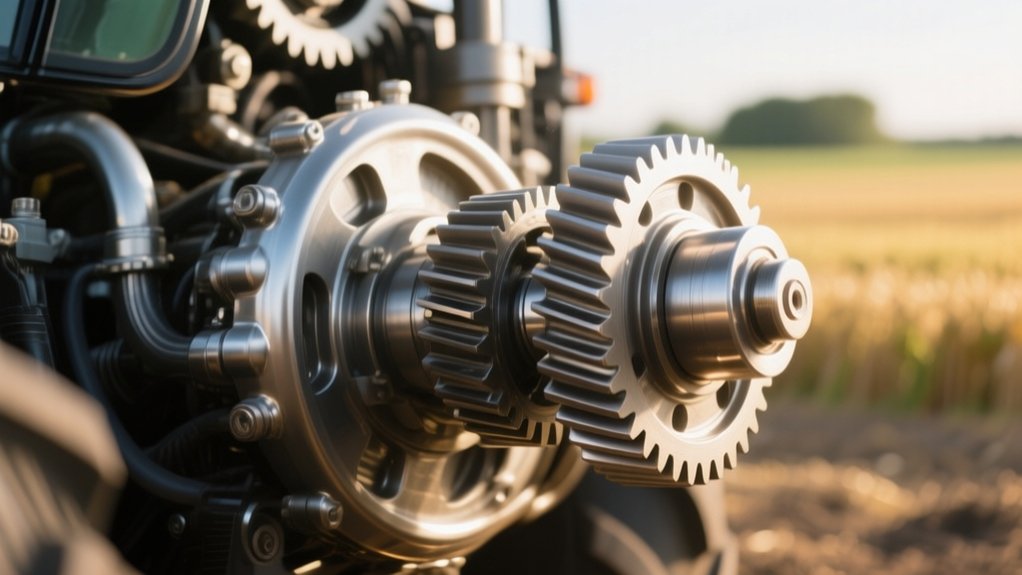
How Does a Tractor Powershift Transmission Work Step by Step
A tractor powershift transmission works by using hydraulic clutches to engage and disengage planetary gears smoothly while you drive, allowing seamless gear changes without stopping or using a clutch pedal. Hydraulic pressure precisely controls clutch packs to transfer power continuously, adjusting for load and speed. Electronic sensors help time shifts perfectly to avoid jerks or gear damage. This system keeps your tractor running efficiently under all conditions, and you can explore the details of its components and maintenance next.
Key Takeaways
- Hydraulic clutches engage and disengage planetary gears to change tractor speeds without interrupting power flow.
- Pressurized hydraulic fluid controlled by valves modulates clutch pressure for smooth, seamless gear shifts under load.
- Electronic sensors monitor engine and load conditions, automating clutch engagement timing for efficient shifting.
- Overlapping clutch engagement transfers torque gradually, maintaining continuous power delivery during gear transitions.
- The valve body directs hydraulic fluid flow to control gear changes, preventing abrupt power jumps and transmission damage.
What Is a Tractor Powershift Transmission
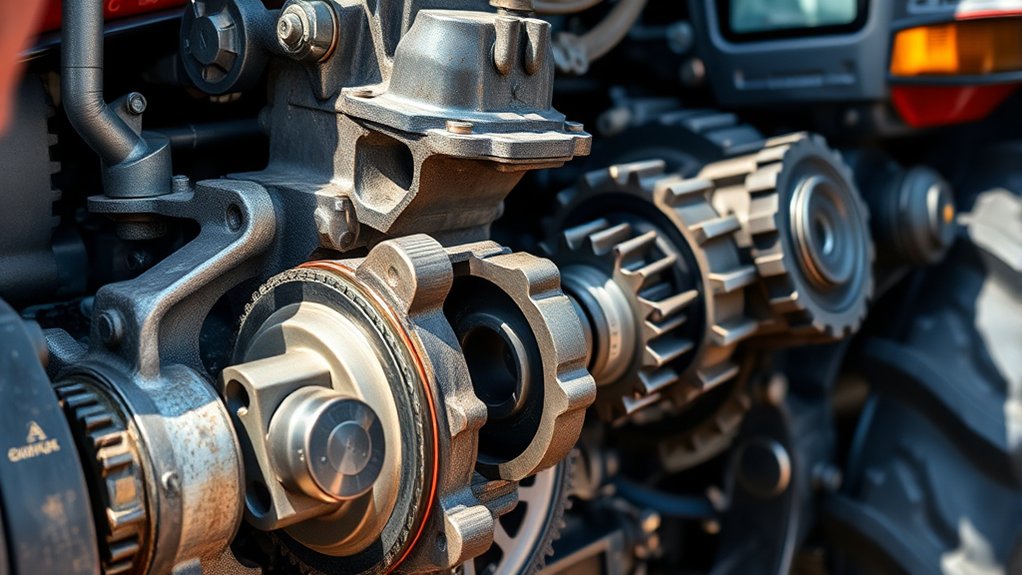
Although you mightn’t realize it, a tractor powershift transmission lets you change gears smoothly without stopping or using the clutch. This system uses multiple sets of planetary gears and hydraulic clutches controlled by a valve body.
When you shift gears, hydraulic pressure engages and disengages these clutches, allowing seamless gear changes under load. Because the clutches operate independently, you can shift between gears quickly and efficiently, which improves your work speed and comfort.
The transmission also manages torque distribution to maintain power delivery without interruption. You don’t have to worry about coordinating clutch pedals or stopping to shift, making your driving experience much easier.
In fundamental terms, the powershift transmission combines mechanical and hydraulic elements to give you precise control and smooth operation in tough field conditions.
How Powershift Transmissions Differ From Manual Ones
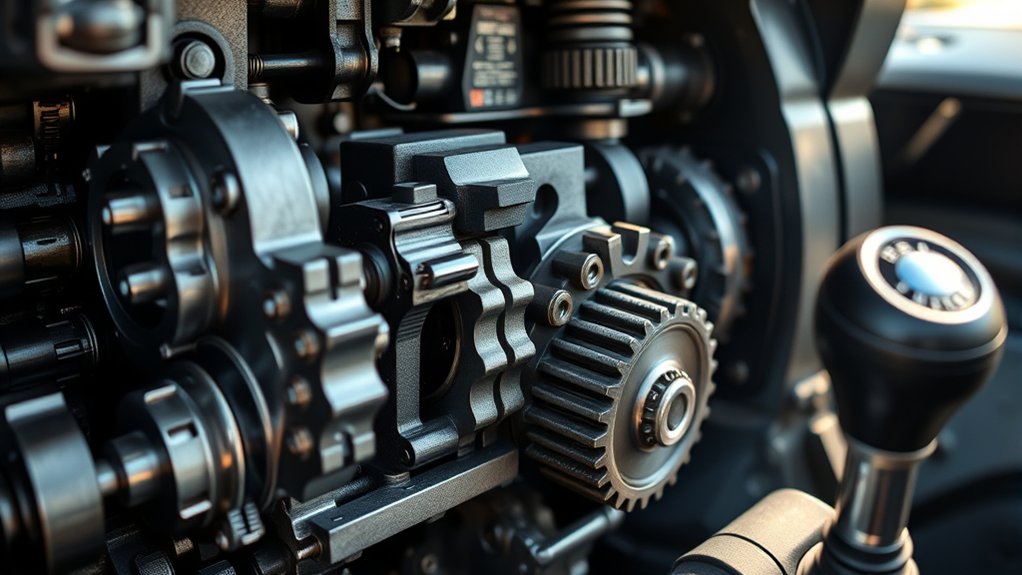
When you switch from a manual transmission to a powershift transmission, you’ll notice a major difference in how you change gears. With powershift, you don’t need to manually operate a clutch or stop moving to shift. Instead, the transmission lets you shift gears smoothly under load, keeping your tractor moving efficiently.
Here’s how powershift transmissions differ from manual ones:
- You don’t have to use a clutch pedal; shifting is done hydraulically or electronically.
- Gear changes happen seamlessly without interrupting power flow.
- You can shift gears on the go, even under heavy load conditions.
- The system reduces operator fatigue by simplifying gear changes.
This makes powershift transmissions more user-friendly and efficient for demanding fieldwork.
Common Powershift Transmission Layouts Explained
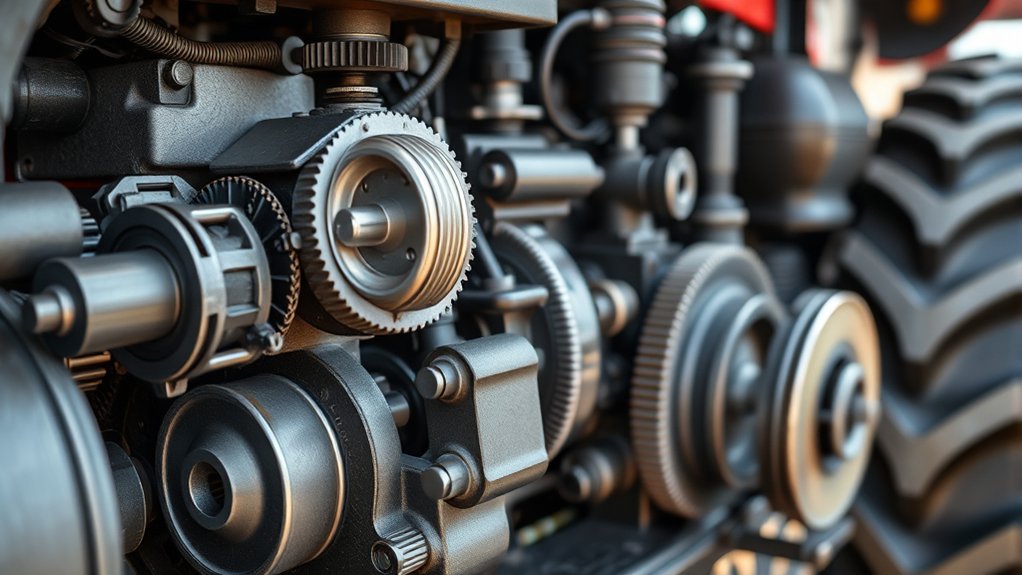
How do different powershift transmission layouts impact your tractor’s performance? Understanding these layouts helps you choose the right tractor for your needs.
The most common layout is the planetary gear system, which uses multiple gear sets to provide smooth, seamless shifting under load without interrupting power flow.
Another layout is the modular design, where individual clutch packs control gear changes, offering easier maintenance and enhanced durability.
Some tractors use a combination of both, balancing efficiency and reliability.
These layouts affect how efficiently power transfers to the wheels, influencing fuel economy, responsiveness, and overall control.
Key Components Inside a Powershift Transmission
Now, let’s look at the key components inside a powershift transmission that make it work smoothly. You’ll find main gears, a hydraulic control system, and clutch packs all playing essential roles.
Understanding how each part functions will help you see the transmission’s full operation.
Main Gears Overview
What makes the main gears inside a powershift transmission so essential? They’re the heart of your tractor’s ability to change speeds smoothly without interrupting power flow. These gears handle different torque levels and speed ranges, allowing your tractor to adapt to varying field conditions effortlessly.
Inside the powershift transmission, the main gears:
- Transmit engine power efficiently to the wheels
- Enable multiple gear ratios for versatile speed control
- Work in sync to provide seamless shifting under load
- Withstand high torque and stress for durability
Hydraulic Control System
The main gears set the foundation for your tractor’s smooth power delivery, but it’s the hydraulic control system that manages how those gears engage and shift under load. This system uses pressurized hydraulic fluid to activate valves and actuators, directing power to different gear sets.
You’ll find a hydraulic pump, control valves, and a network of passages working together to regulate fluid flow precisely. When you select a gear or change speeds, the system adjusts pressure to engage the right components seamlessly.
Sensors and electronic controls often monitor and fine-tune this process, ensuring quick, smooth shifts without interrupting power flow. Without this hydraulic control, your powershift transmission wouldn’t fluidly transition between gears, making your tractor less efficient and harder to operate.
Clutch Packs Function
Although the hydraulic control system manages gear engagement, clutch packs actually handle the power transfer within the transmission. When you shift gears, these clutch packs engage or disengage to smoothly transfer torque from the engine to the drivetrain.
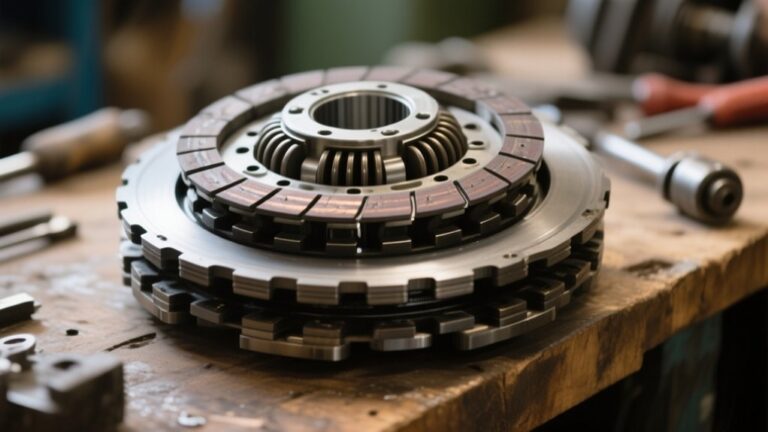
They consist of alternating friction plates and steel plates that compress under hydraulic pressure, allowing power flow without interruption. Your tractor relies on these packs for quick, seamless shifts without stopping.
Here’s what clutch packs do for you:
- Transmit engine power efficiently
- Allow smooth, step-free gear changes
- Prevent drivetrain shock and wear
- Enable precise control under load
Understanding clutch packs helps you appreciate how your tractor delivers power reliably while you work.
Engaging Clutch Packs for Smooth Shifts
When you engage the clutch packs in a tractor’s powershift transmission, you’re directly controlling the flow of power between gears to guarantee smooth shifting. You activate hydraulic pressure that compresses the clutch plates together, allowing torque to transfer seamlessly.
By carefully modulating this pressure, you avoid abrupt power jumps that can damage the transmission or cause jerky movements. As one clutch pack disengages, another simultaneously engages, ensuring continuous power delivery without interruption.
You rely on sensors and control systems to time these actions precisely, matching engine speed and load conditions. This coordination lets you shift gears under load without stopping, improving efficiency and operator comfort.
Mastering clutch pack engagement is key to maintaining the transmission’s performance and longevity.
Using Planetary Gear Sets to Change Speeds
You’ll find that planetary gear sets are key to changing speeds in a powershift transmission. These sets include a sun gear, planet gears, and a ring gear working together to vary output speed.
Understanding how they interact helps you see how the transmission smoothly shifts power.
Planetary Gear Components
Understanding planetary gear components is key to grasping how a powershift transmission changes speeds. When you look inside, you’ll find a compact system designed to efficiently distribute power and vary output speeds without interrupting torque flow. The main parts work together seamlessly to deliver smooth shifts.
Here are the essential components you’ll encounter in a planetary gear set:
- Sun Gear: The central gear that drives or is driven by the system.
- Planet Gears: Multiple gears orbiting the sun gear, mounted on a carrier.
- Planet Carrier: Holds the planet gears and transfers torque to the output.
- Ring Gear: The outer gear that meshes with the planet gears, often fixed or used for input/output.
Each part plays a specific role in controlling speed and torque within the powershift transmission.
Speed Variation Mechanism
The planetary gear components work together to vary speeds by selectively locking or releasing specific elements like the sun gear, planet carrier, or ring gear. When you engage or disengage these parts, the gear set changes its configuration, altering the output speed and torque.
For example, locking the ring gear while allowing the sun gear to spin will produce one speed ratio, whereas holding the planet carrier stationary creates another. This flexibility lets you shift smoothly between different speeds without interrupting power flow.
In a powershift transmission, hydraulic clutches and brakes control which gear elements are locked or free, giving you seamless speed variation. By managing these actions precisely, the transmission adjusts the tractor’s speed efficiently, matching the load and terrain demands without manual clutching.
Managing Torque Flow During Gear Changes
Although shifting gears might seem instantaneous, managing torque flow during gear changes in a tractor powershift transmission requires precise coordination. You need to guarantee the power delivery remains smooth to avoid jerks or damage.
Smooth torque management during gear shifts is essential to prevent jerks and protect the transmission.
The transmission carefully modulates torque by momentarily balancing forces between the outgoing and incoming gear sets. This prevents sudden drops or spikes in power to the wheels.
To manage torque flow effectively, the system focuses on:
- Synchronizing clutch engagement and release timing
- Maintaining continuous power flow during progressions
- Gradually transferring torque to avoid shock loads
- Monitoring load conditions to adjust torque modulation dynamically
How Hydraulic Systems Control Powershift Transmission Shifts
You’ll see that hydraulic pressure regulation plays a key role in controlling powershift transmission shifts. The system uses shift valves to direct this pressure precisely where it’s needed.
Understanding how these components work together reveals how smooth gear changes happen.
Hydraulic Pressure Regulation
When you engage a powershift transmission, hydraulic pressure plays a crucial role in controlling the shifts smoothly and efficiently. It guarantees that the right amount of force is applied to the clutches and bands inside the transmission, allowing gear changes without interruption.
The system constantly monitors and adjusts pressure to match engine load and speed, preventing slippage or harsh engagements.
Hydraulic pressure regulation involves:
- Maintaining consistent pressure levels to avoid shift shock
- Adjusting pressure based on operator input and tractor load
- Using pressure relief valves to prevent system overload
- Balancing pressure between multiple clutch packs for seamless progressions
Shift Valve Operation
Because hydraulic systems rely on precise control, shift valves play a key role in managing powershift transmission changes. When you engage a gear shift, the transmission control unit sends a signal that directs hydraulic fluid flow through these valves.
The shift valves then open or close specific passages, controlling which clutch packs receive pressure. This action enables smooth gear engagement without interrupting power delivery.
You’ll find that the valves respond quickly to changes in pressure, ensuring timely shifts and preventing gear clash. By regulating fluid direction and pressure, shift valves maintain the seamless operation of the powershift transmission.
Understanding how shift valves function helps you grasp how your tractor shifts gears efficiently, combining hydraulic precision with mechanical power to optimize performance in the field.
How Electronic Controls Automate Gear Changes
How exactly do electronic controls streamline gear changes in a tractor powershift transmission? They use sensors and microprocessors to monitor engine speed, load, and driver input, then instantly adjust hydraulic pressure to shift gears smoothly. This automation eliminates manual clutching, reducing operator effort and wear on components.
You benefit from more precise, faster shifts that adapt to changing conditions without losing power.
Electronic controls automate gear changes by:
- Continuously monitoring key transmission and engine parameters
- Sending real-time commands to shift valves
- Modulating hydraulic pressure for smooth engagement
- Preventing gear clashes through precise timing
Why Powershift Transmissions Keep Power to the Wheels
You rely on powershift transmissions because they deliver continuous torque without interruption.
The clutch engagement mechanism lets the system switch gears smoothly while keeping power flowing to the wheels.
Understanding this process shows why your tractor maintains steady movement during gear changes.
Continuous Torque Delivery
While shifting gears in a tractor, you don’t lose power to the wheels thanks to the powershift transmission’s design. It maintains continuous torque delivery by overlapping the engagement of gears. This means one gear is always transmitting power while the next gear prepares to take over smoothly. You experience seamless changeovers without any drop in force, keeping your tractor moving steadily.
Key factors enabling continuous torque delivery include:
- Multiple clutch packs that alternate power flow
- Hydraulic controls coordinating gear shifts precisely
- Planetary gear sets that distribute torque evenly
- Real-time monitoring systems adjusting pressure instantly
Clutch Engagement Mechanism
The continuous torque delivery relies heavily on the clutch engagement mechanism to keep power flowing to the wheels without interruption. When you shift gears in a powershift transmission, multiple clutches engage and disengage smoothly to transfer power seamlessly. These clutches operate hydraulically, controlling which gear set connects to the output shaft.
You don’t experience any jerks or loss of power because one clutch starts engaging before another fully releases. This overlap ensures the tractor keeps moving steadily. The system’s precision prevents downtime and stress on components, letting you focus on your work.
Top Benefits of Powershift Transmissions for Farmers
Because powershift transmissions allow seamless gear changes without stopping, you’ll experience smoother operation and less downtime during your workday. This means you can focus more on the task at hand without worrying about shifting gears manually or halting your tractor’s movement.
Powershift transmissions enable smooth, uninterrupted gear changes for a more efficient and focused workday.
You’ll also enjoy better fuel efficiency, reduced wear on transmission components, and improved overall productivity.
Here are the top benefits you’ll gain from a powershift transmission:
- Effortless gear changes without clutching or stopping
- Increased traction and control in varying field conditions
- Enhanced comfort with less physical strain during long hours
- Quicker response times to changing load demands and terrain
With these advantages, your farming operations will run more efficiently and comfortably.
Essential Maintenance Tasks for Powershift Transmissions
Enjoying the smooth performance and reliability of your powershift transmission means you’ll want to keep it in top shape.
Start by regularly checking the transmission fluid level and quality—dirty or low fluid can cause slipping or overheating. Change the fluid and filter according to the manufacturer’s schedule to maintain proper lubrication and cooling.
Inspect the transmission for leaks and worn seals, addressing any issues promptly to prevent damage.
Keep the cooling system clean to avoid overheating, which can shorten transmission life.
Finally, schedule routine professional inspections to catch early signs of wear or malfunction.
Troubleshooting Common Powershift Transmission Issues
When your powershift transmission starts acting up, knowing how to pinpoint common issues can save you time and money.
First, check for slipping gears, which often signal low hydraulic fluid or worn clutch packs.
Next, watch for delayed shifting; this might indicate clogged filters or failing solenoids.
Overheating is another red flag—inspect the cooling system and fluid levels regularly.
Finally, unusual noises can stem from worn bearings or damaged gears.
Keep an eye on these key problems:
- Slipping or jerking during gear changes
- Delayed or hard shifting
- Overheating transmission fluid
- Grinding or knocking sounds
Addressing these issues early helps maintain your tractor’s performance and prevents costly repairs down the line.
How to Maximize Efficiency When Operating a Powershift Tractor
Keeping your powershift transmission in good shape by addressing common issues like slipping gears and overheating is just the start.
To maximize efficiency, operate your tractor within the recommended RPM range to avoid unnecessary strain.
Shift gears smoothly without forcing the lever, as abrupt changes can damage components and waste fuel.
Regularly check and maintain proper transmission fluid levels and replace filters on schedule to guarantee optimal hydraulic performance.
Use the cruise control feature, if available, to maintain steady speed and reduce fuel consumption during long tasks.
Finally, avoid overloading the tractor beyond its capacity, as this increases wear and reduces efficiency.
Frequently Asked Questions
What Is the History of Tractor Powershift Transmissions?
You’ll find tractor powershift transmissions emerged in the mid-20th century, revolutionizing farming by letting you shift gears without stopping. Manufacturers like John Deere and Massey Ferguson led this innovative leap for smoother operation.
Which Tractor Brands Use Powershift Transmissions?
John Deere and Case IH use powershift transmissions, while New Holland and Kubota often prefer CVTs. You’ll find these brands choosing differently, but they all want smooth, efficient power delivery for your tractor work.
How Do Powershift Transmissions Affect Fuel Consumption?
You’ll notice powershift transmissions can improve fuel efficiency by allowing smoother, quicker gear changes without clutching. This keeps the engine running ideally, reducing fuel waste during shifts and helping you save fuel during your work.
Can Powershift Transmissions Be Retrofitted to Older Tractors?
You generally can’t retrofit powershift transmissions to older tractors easily because they require specific design features. Instead, you’d usually need a new transmission system built for your tractor’s model and compatibility.
Are Powershift Transmissions Compatible With All Types of Farming Equipment?
You won’t find powershift transmissions compatible with all farming equipment since they’re designed mainly for tractors. Some implements require specific power inputs or mechanical setups, so always check compatibility before connecting or upgrading.
Conclusion
Now that you understand how a tractor powershift transmission works, you can appreciate its impact on farming efficiency. Did you know that powershift transmissions can reduce shift times by up to 70% compared to manual gearboxes? This means smoother operation and less downtime for you in the field. With proper maintenance and smart use, your powershift tractor will keep running strong, helping you get more done with less effort every day.