Is a Lawn Mower a Tractor?
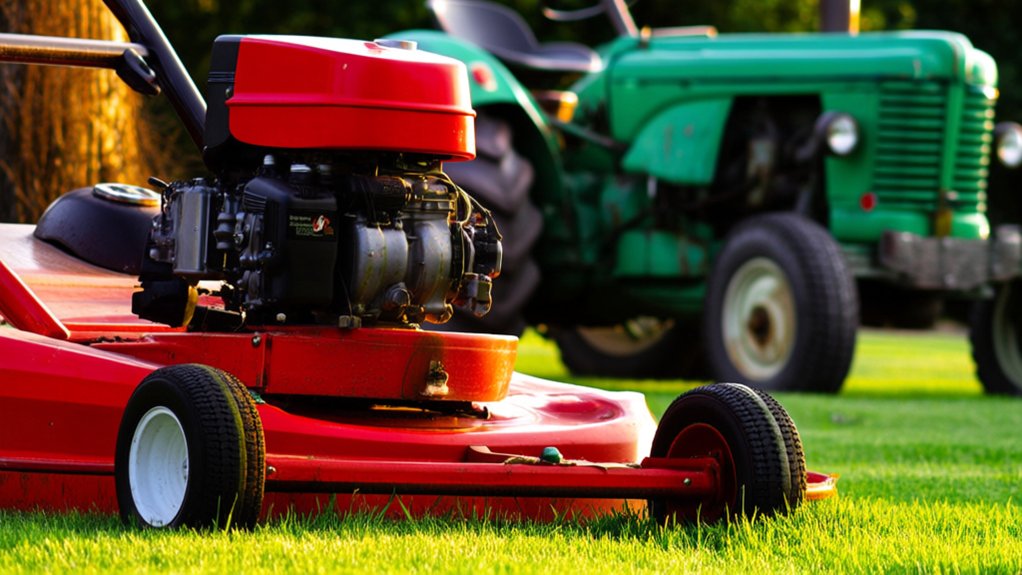
You might think a lawn mower and a tractor are the same, but they serve very different purposes. A lawn mower is designed for cutting grass on smaller, flat yards and is easy to maneuver. A tractor, on the other hand, is built for heavy-duty tasks like plowing, hauling, and handling rough terrain. Some machines blur the lines, offering mixed functions. If you want to understand which suits your needs best, keep exploring their key differences and uses.
Key Takeaways
- A lawn mower is specifically designed for cutting grass on small to medium lawns, unlike tractors built for heavy-duty tasks.
- Tractors have larger engines, heavy-duty frames, and support various attachments beyond mowing, making them more versatile than lawn mowers.
- Lawn mowers are compact, easier to maneuver, and ideal for flat, even terrain, whereas tractors handle rough terrain and slopes effectively.
- Lawn mowers primarily cut grass and handle light yard maintenance, while tractors perform plowing, hauling, tilling, and landscaping tasks.
- Some riding mowers with attachments can function like mini-tractors, but standard lawn mowers are not classified as tractors.
Lawn Mower vs. Tractor: Key Differences Explained
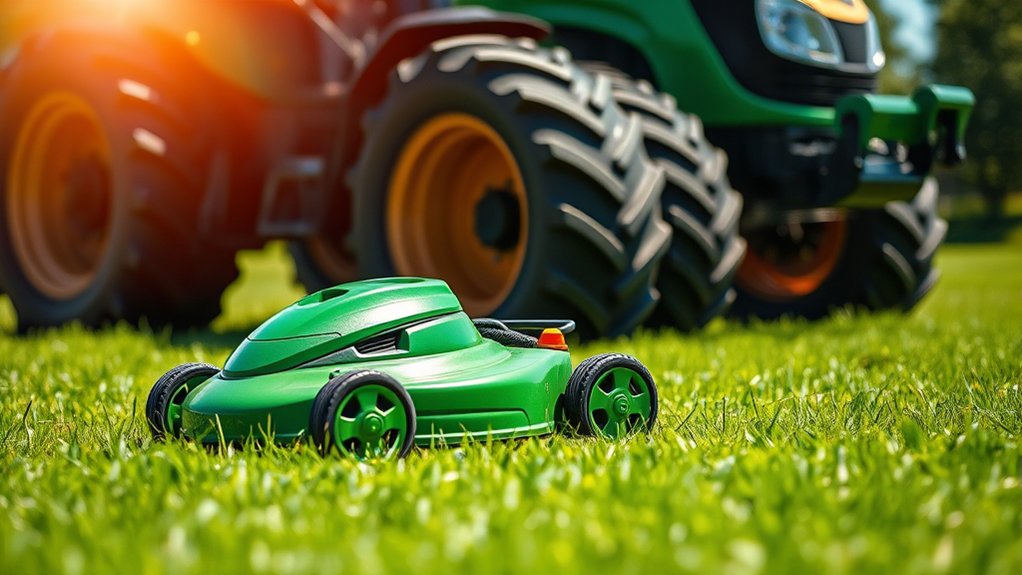
Although both lawn mowers and tractors are used for outdoor maintenance, they serve very different purposes. When you use a lawn mower, your main goal is cutting grass efficiently and neatly. Lawn mowers are designed specifically for this task, offering precision and ease in handling smaller yards.
On the other hand, tractors are built for heavy-duty work like plowing, hauling, and tilling on larger properties or farms. You’ll notice tractors have more power, larger wheels, and the ability to attach various implements for different jobs.
While a lawn mower focuses on maintaining your lawn, a tractor handles a wide range of outdoor tasks beyond just cutting grass. Understanding these differences helps you choose the right machine for your needs.
How Lawn Mowers Are Designed to Cut Grass
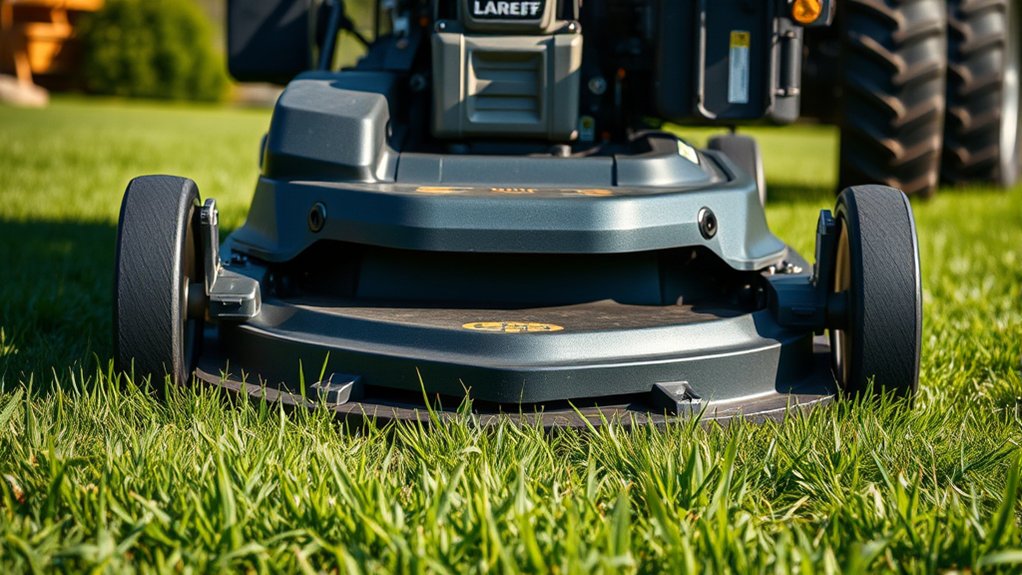
How exactly do lawn mowers manage to cut grass so evenly and efficiently? They’re designed with precision to keep your lawn looking sharp without much effort from you. When you use a mower, its sharp blades spin rapidly, slicing through grass blades like a knife through butter. The mower’s deck helps guide the cut grass out, preventing clogs and ensuring uniformity.
Here’s how they work their magic:
- Sharp, rotating blades cut grass cleanly and consistently.
- Adjustable cutting heights let you control how short or tall your lawn stays.
- Powerful engines keep blade speed steady for smooth cutting.
- The mower’s deck design directs clippings away, avoiding uneven patches.
You’ll appreciate how these features make lawn care simple and satisfying.
Why Tractors Handle Heavy-Duty Tasks Better
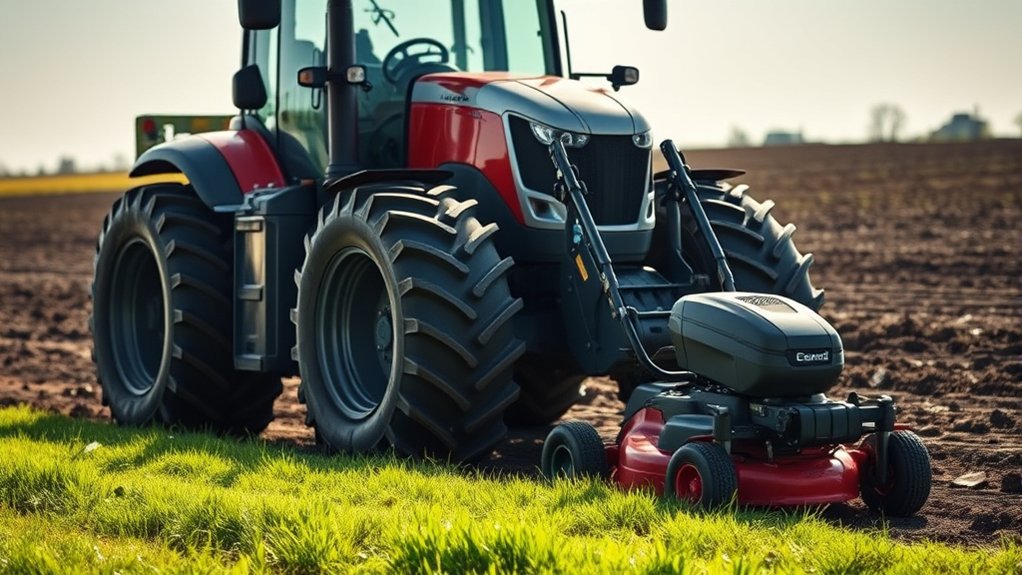
Because tractors are built with robust engines and heavy frames, they can tackle tasks that lawn mowers simply can’t handle. When you need strength and durability for tough jobs, tractors outperform lawn mowers every time. Their design allows them to pull heavy equipment, work uneven terrain, and last longer under stress.
Here’s a quick comparison:
| Tractors | Lawn Mowers |
|---|---|
| Powerful engine for heavy work | Smaller engine for cutting grass |
| Heavy-duty frame and tires | Lightweight and maneuverable |
| Designed for towing and hauling | Built just for mowing |
Parts That Differentiate Lawn Mowers and Tractors
You’ll notice that engine power plays a big role in setting lawn mowers and tractors apart. Tractors usually handle stronger engines built for heavy tasks.
While lawn mowers focus on lighter power for cutting grass.
Plus, attachment compatibility varies, with tractors designed to support a wider range of tools compared to lawn mowers.
Engine Power Differences
What sets a lawn mower apart from a tractor most noticeably is the engine power under the hood. When you compare the two, you’ll find that tractors are built to handle tougher jobs with more muscle.
Here’s how engine power differences stand out:
- Lawn mowers usually have engines under 25 horsepower, perfect for cutting grass but limited beyond that.
- Tractors boast engines ranging from 20 to over 100 horsepower, giving them the strength to tow and plow.
- The torque in tractors is markedly higher, letting you work longer and harder without strain.
- Lawn mowers focus on speed and maneuverability, while tractors prioritize raw power and endurance.
Understanding these differences helps you pick the right machine for your needs.
Attachment Compatibility
How do attachment options set lawn mowers and tractors apart? When you look at compatibility, tractors clearly outshine lawn mowers. Tractors support a wide range of attachments like plows, seeders, and loaders, making them versatile for many tasks. Lawn mowers, in contrast, typically handle just a few attachments such as grass catchers or mulching kits.
| Attachment Type | Lawn Mower Compatibility | Tractor Compatibility |
|---|---|---|
| Plow | No | Yes |
| Grass Catcher | Yes | Sometimes |
| Loader | No | Yes |
You’ll notice tractors adapt to diverse jobs through attachments, while lawn mowers stay limited to basic lawn care accessories. This difference plays a key role in defining their distinct purposes.
Types of Lawn Mowers and Tractors Explained
Although both lawn mowers and tractors serve to maintain and manage outdoor spaces, they come in various types designed for specific tasks. You’ll find that knowing these types helps you pick the right tool for your yard.
- Push Lawn Mowers – Lightweight and easy to maneuver, perfect for small lawns.
- Riding Lawn Mowers – Great if you want comfort and speed on medium-sized lawns.
- Garden Tractors – More powerful, designed for heavy-duty lawn care and light hauling.
- Utility Tractors – Built for tough jobs, they handle large properties and multiple attachments with ease.
Understanding these types makes maintaining your outdoor space less of a chore and more of a rewarding experience.
Common Uses for Lawn Mowers and Their Limits
You use lawn mowers mainly for cutting grass on small to medium-sized lawns. However, they struggle with rough terrain and large areas.
Plus, their limited attachments mean they can’t handle many tasks that tractors manage.
Typical Lawn Mower Tasks
While lawn mowers excel at cutting grass quickly and evenly, they’re designed primarily for maintaining residential lawns and small yards. You rely on them to keep your grass tidy without much hassle, but it’s important to know what tasks they handle best.
Here are typical lawn mower tasks you’ll use yours for:
- Trimming grass on flat, even surfaces – perfect for that neat, manicured look.
- Mulching leaves and grass clippings – helps feed your lawn naturally.
- Bagging clippings for easy disposal – keeps your yard clean and tidy.
- Edge trimming around flower beds and walkways – sharpens your landscape’s appearance.
Stick to these tasks, and your mower will serve you well without pushing its limits.
Size and Terrain Limits
How much ground can a lawn mower realistically cover before it struggles? Most lawn mowers handle small to medium-sized yards efficiently, usually up to an acre. Beyond that, the time and effort increase considerably, making larger areas cumbersome.
You’ll notice that lawn mowers perform best on relatively flat, even terrain. Hilly or uneven ground can challenge their stability and cutting consistency, causing you to work harder to maintain control and safety.
Rough or rocky surfaces may damage blades or wheels, limiting mowing effectiveness. If your property has steep slopes or extensive rough patches, a lawn mower mightn’t be the best fit.
Understanding these size and terrain limits helps you choose the right equipment without pushing your mower beyond its capabilities.
Attachment and Function Restrictions
Although lawn mowers excel at cutting grass, they’ve clear limits when it comes to attachments and additional functions. You can’t expect your mower to handle heavy-duty tasks like plowing or hauling. Unlike tractors, most lawn mowers don’t support a wide range of attachments, which restricts their versatility.
Here’s why that matters:
- You can usually only attach simple tools like grass catchers or small trailers.
- Lawn mowers lack the power and hydraulic systems needed for complex implements.
- Trying to use incompatible attachments can damage your mower or pose safety risks.
- Their design focuses on mowing, so they aren’t built for soil cultivation or snow removal.
Understanding these limits helps you avoid frustration and choose the right equipment for the job.
Typical Tractor Jobs Beyond Mowing
Because tractors are built for versatility, they handle far more than just mowing your lawn. You can use them to till soil, preparing your garden or field for planting. Tractors also help with hauling heavy loads, whether it’s firewood, tools, or harvested crops, saving you time and effort.
When equipped with a loader, you can easily move dirt, gravel, or debris around your property. Some tractors even support snow removal in winter, keeping driveways and walkways clear.
Beyond yard work, tractors assist in landscaping tasks like grading and leveling land, making them invaluable for larger projects. This range of jobs shows why tractors are true workhorses, designed to tackle diverse tasks beyond the simple act of cutting grass.
How Size and Power Separate Lawn Mowers From Tractors
When you compare lawn mowers to tractors, their size and power stand out as the most obvious differences. Lawn mowers are designed to be compact and lightweight, making them easy to maneuver in tight spaces. Tractors, on the other hand, are built large and powerful to handle heavy-duty tasks beyond just cutting grass.
Here’s how size and power set them apart:
- Engine Strength: Mowers have smaller engines, perfect for light mowing, while tractors boast high-horsepower engines for tough jobs.
- Weight: Tractors are much heavier, providing stability on rugged terrain.
- Dimensions: Mowers fit in your garage; tractors often need more storage space.
- Capacity: Tractors can handle attachments; mowers usually can’t.
These differences mean you’ll feel the power shift the moment you switch from a mower to a tractor.
When to Choose a Lawn Mower Over a Tractor
If your lawn is relatively small and flat, a lawn mower will serve you well without the need for extra power or size. You’ll find it easier to maneuver in tight spaces, and it’s lighter, so storing and transporting it won’t be a hassle.
Lawn mowers are also more cost-effective, both in upfront price and maintenance, making them ideal if you want to keep expenses low. You don’t need a tractor’s heavy-duty capabilities for routine mowing tasks, especially if your property doesn’t require towing attachments or handling rough terrain.
Choosing a lawn mower means you get efficiency and simplicity without overcomplicating your lawn care. It’s perfect for typical residential yards where ease of use and accessibility matter most.
When a Tractor Is the Better Choice Than a Lawn Mower
You’ll find a tractor works better when the terrain gets rough or uneven, offering more power and durability than a standard lawn mower.
If your tasks go beyond simple mowing—like hauling or tilling—a tractor’s versatility really shines.
Understanding these differences helps you pick the right machine for your needs.
Terrain Complexity
How do you handle uneven or challenging terrain in your yard? If you’re dealing with slopes, rocky patches, or thick brush, a lawn mower might just not cut it.
Tractors are built to tackle tough landscapes, giving you better stability and power.
Consider these reasons why a tractor is the smarter choice for complex terrain:
- Superior traction on hills keeps you safe and steady.
- Higher ground clearance prevents damage from rocks and roots.
- Stronger engines power through dense vegetation without stalling.
- Durable tires reduce the risk of getting stuck in mud or loose soil.
When your yard tests your equipment, choose the machine that won’t let you down—your tractor.
Task Versatility
Because tractors come equipped with various attachments and powerful capabilities, they handle a wider range of tasks than lawn mowers. When you need to plow, till soil, haul heavy loads, or clear snow, a tractor is your go-to machine.
Unlike lawn mowers, tractors can switch between implements like front loaders, backhoes, and spreaders, making them invaluable on farms and large properties. If your work goes beyond just cutting grass—say, moving dirt or transporting equipment—a tractor will save you time and effort.
Lawn mowers stick to mowing; tractors adapt to multiple jobs. So, if versatility is key to your outdoor needs, choosing a tractor over a lawn mower makes practical sense. You’ll get more done without switching machines constantly.
Power And Durability
When you need a machine that can handle tough jobs day after day, power and durability become top priorities. A tractor outshines a lawn mower when the terrain gets rough or the workload intensifies. You want a machine built to last and perform without faltering.
Here’s why a tractor is often the better choice:
- Stronger Engine: Tractors pack more horsepower to tackle thick grass, uneven ground, and heavy attachments.
- Heavy-Duty Build: Their robust frames withstand constant use and harsh conditions.
- Longer Lifespan: Tractors are engineered for years of reliable service, reducing replacement frequency.
- Better Traction: Larger tires and weight distribution help you maneuver challenging landscapes confidently.
If you need power and durability, a tractor won’t let you down.
Can Some Machines Function as Both Lawn Mowers and Tractors?
Can a single machine really handle both mowing your lawn and performing tractor tasks? Yes, some machines are designed to do just that. Riding lawn mowers with attachments can function as mini-tractors, letting you mow grass and haul small loads or till soil.
These versatile machines save you space and money by combining functions. However, their capacity is limited compared to full-sized tractors. If your tasks include heavy-duty work, you might need a dedicated tractor.
Yet, for typical yard maintenance and light farm chores, these hybrid machines offer convenience. When choosing one, consider the attachments available and the machine’s power. That way, you guarantee it meets your mowing and tractor needs efficiently without overpaying for unnecessary features.
Frequently Asked Questions
What Is the History of Lawn Mowers and Tractors?
You’ll find lawn mowers began in 1830 with Edwin Budding’s invention, while tractors evolved from steam engines in the late 19th century. Both transformed farming and gardening by making tasks faster and easier for you.
How Do Maintenance Costs Compare Between Lawn Mowers and Tractors?
You’ll find lawn mowers generally cost less to maintain than tractors since they have simpler engines and parts. However, if you use a tractor for heavy work, its maintenance costs might increase due to more complex components.
Are There Environmental Impacts Unique to Lawn Mowers or Tractors?
You might think lawn mowers and tractors impact the environment similarly, but they don’t. Lawn mowers usually produce more pollution per hour, while tractors can cause soil compaction and habitat disruption, affecting ecosystems uniquely.
What Safety Precautions Are Essential for Using Lawn Mowers?
You should always wear sturdy shoes, avoid loose clothing, and keep children away. Make sure blades are sharp, never mow wet grass, and turn off the mower before cleaning or adjusting to stay safe while mowing.
Can You Rent a Tractor or Lawn Mower Instead of Buying One?
Yes, you can rent both tractors and lawn mowers from equipment rental stores. Renting lets you save money, try different models, and avoid maintenance hassles. Just check rental terms and availability before you commit.
Conclusion
You might wonder if a lawn mower is a tractor, but they’re built for different jobs. Picture a lawn mower as a nimble artist, trimming grass with precision, while a tractor is a powerful builder, handling tough tasks like plowing and hauling. Some machines blur the lines, offering both functions, but knowing when to choose each helps you work smarter. So, think about your needs—cutting grass or heavy-duty work—to pick the right tool for the job.